Preview
Install
copilot plugin install foundry-agentic-loop@awesome-copilotOr open Foundry Agentic Loop Workflow directly in the Copilot app.
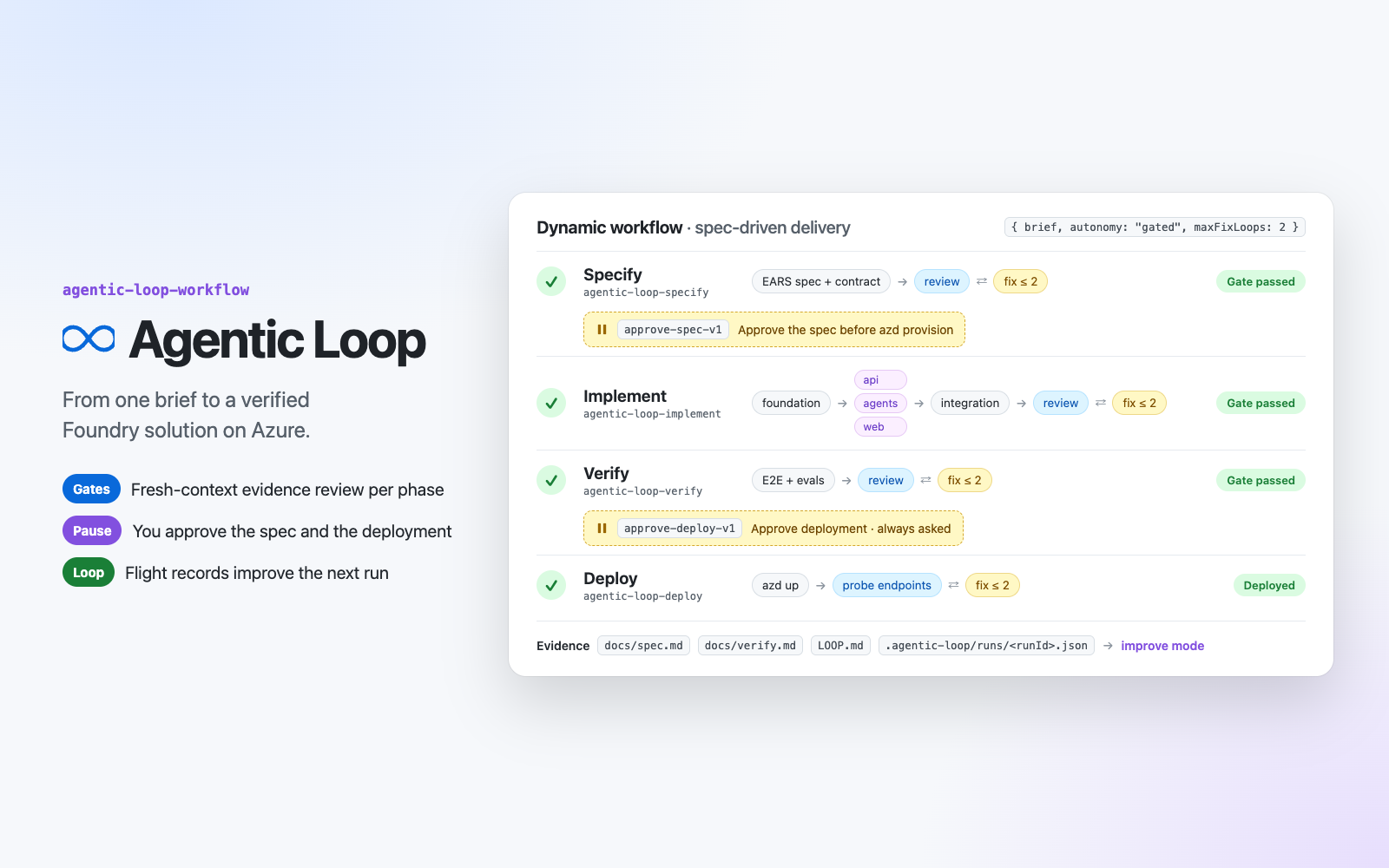
A GitHub Copilot dynamic workflow that turns a brief into a verified Microsoft Foundry solution on Azure. It runs four phases in sequence:
- Specify: EARS spec, frozen contract and deployment plan.
- Implement: azd scaffold and provision, a hosted checkpoint, then parallel workstreams and integration.
- Verify: local E2E, a hosted invocation, telemetry and evaluations.
- Deploy:
azd up, health checks and deployed E2E.
It ships with the foundry-agentic-loop plugin. The SDD mode of the foundry-agentic-loop skill starts it, and the Foundry Agentic Loop canvas shows its progress.
At setup, it adds the Agentic Loop SDD section to the workspace root AGENTS.md unless one exists. The section locks the workspace to SDD and routes short commands such as deploy, status and resume in later prompts. A workspace locked to rapid prototyping stops the run until Copilot converts the prototype to SDD.
One run is active per workspace. The run holds a lease in .agentic-loop/active-run.json (runId, startedAt, heartbeatAt), refreshes it with every flight record write and every five minutes, and releases it when it pauses, fails or finishes. A second run refuses to start while the lease is fresh (heartbeat under 30 minutes old) and names the active run; delete the file if that run is gone. A stale lease is taken over with a Chat line, and resuming a run takes its lease back. Every lease read-check-write runs under an exclusive .agentic-loop/active-run.lock folder, so two runs cannot both take over the same stale lease; a lock older than two minutes is left by a crash and must be deleted.
The workflow reads and writes its own files (AGENTS.md, .agentic-loop/, .agentic-loop/runs/, the record, lease and waiver files) only inside the workspace: a symbolic link on any of those paths, or a path that resolves outside the workspace, stops the run with an error instead of being followed. It never writes docs/LOOP.md itself; subagents do.
How a phase runs
Each phase follows its guide in the foundry-agentic-loop skill (references/specify.md, implement.md, verify.md or deploy.md) in fresh-context subagents, using microsoft-foundry for platform operations. Subagents stay inside the workspace, read skills from the paths resolved at setup and delete only Azure resources the run created whose provisioning failed:
- Lead: does the phase work and records lessons in
docs/LOOP.md. - Review: an independent reviewer reruns every check and reports all blocking issues at once, with evidence. Earlier reports count as claims, not evidence.
- Fix: a fixer resolves the issues, then a new review first confirms each one is resolved before finishing its checks. This repeats up to
maxFixLoopstimes. - Implement: the foundation step plans up to four workstreams. If they own disjoint workspace-relative files outside the shared ones the lead keeps, such as
azure.yaml,infra/,docs/and the root lockfiles, they run in parallel before integration; otherwise the build runs in sequence. Implement deploys only the hosted checkpoint services, and only when they changed; the app services deploy in Deploy. - Ownership: before parallel workers start, overlapping or shared ownership falls back to a sequential build. After they finish, the workflow compares
git statuswith a snapshot from before the fan-out and hands every changed path that no workstream owns to integration as an issue. It never reverts changes, and it skips the check outside a git repository. - Retry: a subagent that ends without a report, usually after a provider error, is retried once and told to continue from the current workspace and Azure state. A second miss blocks the gate instead of spending fix loops; for a workstream worker, integration receives it as a failed workstream and finishes it.
The gate passes only on the reviewer's verdict. Reports are untrusted and fail closed: a passed report that still lists issues counts as failed, and in Verify and Deploy a passed report without evidence items ({claim, source, result}, at most 12) counts as failed with an issue asking for evidence. The gate's evidence is kept in the flight record.
Checkpoints
| Checkpoint | When | Resume means |
|---|---|---|
approve-spec-v1 |
After Specify, when autonomy is gated and the run continues past Specify; or before Implement, when a gated run starts at Implement and no recorded spec approval matches the current spec and plan |
The spec and deployment plan are approved for provisioning |
approve-spec-r<n>-v1 |
Before gated Implement round n, when the spec or plan changed since the spec approval | The changed spec is approved again |
approve-deploy-v1 |
Before Deploy, always | Deployment to the planned target is approved |
approve-deploy-r<n>-v1, approve-deploy-r<n>-a<k>-v1 |
Before Deploy round n, or after its attempt k, when the approved files or azd target changed since the last approval | The changed plan is approved again |
blocked-<phase>-r<n> |
A gate failed after its fix loops, a subagent ended twice without a report, or a human decision is needed | The issue is resolved; round n+1 continues from the current state and re-checks it first |
blocked-record-<step> |
The flight record could not be written at a gate, checkpoint or other boundary, even after a retry | The cause is fixed; the record is saved before the run continues |
Each pause posts a Needs you: line in Chat that names the decision. The flight record lists every gate issue, and the canvas shows them. Resume with run_dynamic_workflow and resumeFromRunId, or from the canvas. Completed steps, including every subagent report, replay from the journal, so resuming never repeats finished work.
- Final round: a phase gets at most 20 rounds. The checkpoint after round 20 says the rounds are exhausted and that resuming ends the run; fix the root cause and start a new run, or rerun that phase alone with
fromandto. - Deploy approval: approving deployment records a fingerprint in the flight record (
deployApproval): the SHA-256 of.azure/deployment-plan.md,docs/spec.mdanddocs/verify.md, and the azd environment, subscription, location, resource group and Foundry target (AZURE_FOUNDRY_RESOURCE_GROUP,AZURE_AI_ACCOUNT_NAME,AZURE_AI_PROJECT_NAME) from.azure/<env>/.env(falling back to the args). Before every Deploy round and after every Deploy attempt, the workflow recomputes it and asks again throughapprove-deploy-r<n>-v1orapprove-deploy-r<n>-a<k>-v1if anything changed, so no later step deploys and no gate passes on an unapproved change. Deploy subagents must confirm thatazd env get-valuesandaz account showmatch the fingerprint, and stop as blocked if they don't. A fix that needs to change an approved file or the target makes only that change, without deploying, and reports it. - Spec approval: approving the spec records
specApproval, the SHA-256 ofdocs/spec.mdand.azure/deployment-plan.md. A gated rerun from Implement inherits it only while both still match, and otherwise asks again atapprove-spec-v1, naming what changed. Before every gated Implement round, including one resumed after a pause, the workflow recomputes it and asks again atapprove-spec-r<n>-v1if either file changed. A file that is missing or cannot be read, such as a link, never matches, for spec and deploy approvals alike. - Waivers: only a human waives a gate issue. While the run waits at
blocked-<phase>-r<n>, write.agentic-loop/waivers/<runId>.json(the same file name rule as the record) as[{"issue": "<exact gate issue>", "reason": "..."}], then resume. The workflow accepts a waiver only when the file was written during that pause and the issue matches one of that checkpoint's issues, records it aswaivers: [{issue, reason, approvedAt, checkpoint}], deletes the file and lists accepted waivers in that phase's later prompts. Subagents never waive issues themselves.
Workflow subagents don't appear in list_agents or read_agent. The flight record is saved when the run starts, at the first step that runs after a resume, at each gate, checkpoint, Deploy skip and other journaled event, at the result and on failure, so a quiet hour inside one Implement step is normal. Every write is tried twice. If the record still cannot be written at setup, the run fails; at a later boundary it pauses at blocked-record-<step> with the path and error instead of continuing without a record. Only the best-effort saves at the first step after a resume and on failure log a Flight record not saved line and continue. A cancelled run keeps its last saved status, so the run status from dynamic_workflows_manage (runs or inspect-run) is authoritative. The canvas Build tab shows live subagent activity.
Arguments
| Arg | Default | Meaning |
|---|---|---|
brief |
required | Self-contained brief covering users, agents, data, tools and UX (20–20,000 characters) |
subscriptionId |
current az default |
Target subscription GUID |
location |
auto |
Preferred region. A joint model, quota and service placement check decides |
environmentName |
derived | azd environment name, 2–20 characters |
scenarioId |
none | Canvas prompt template that the run came from |
autonomy |
gated |
gated pauses for spec approval; auto skips that pause |
maxFixLoops |
2 |
Fix rounds per phase gate, 0–5 |
skipDeploy |
false |
End after Verify with status verified |
from |
Specify |
Start at a later phase, for example "Verify". Allowed only when the latest flight record in .agentic-loop/runs/ passed every earlier phase; those phases are recorded as inherited (round: 0, inheritedFrom). Implement and Verify gates also record the SHA-256 of docs/spec.md and .azure/deployment-plan.md they passed on; if either changed since, the run refuses to inherit them and names the phase to start at. Otherwise the run refuses to start. Deploy cannot be combined with skipDeploy |
to |
Deploy (Verify with skipDeploy) |
Last phase to run; later phases are recorded as skipped and the run ends with status specified, implemented, verified or deployed. Set from and to to the same phase to run only that phase. A run that ends at Specify skips the spec approval pause, and Deploy approval is asked only when Deploy runs |
For an unattended run from Specify through Verify, use autonomy: "auto" and skipDeploy: true with copilot workflow run foundry-agentic-loop-workflow --args @args.json --result-file result.json, where --result-file writes only the workflow result. Such a run can still pause at a blocked-<phase>-r<n> checkpoint, and with autonomy: "gated" or without skipDeploy it also pauses for approval. The CLI has no resume command, so continue a paused run from a Copilot session with its run ID.
Limits
META.limits sets default ceilings; override them per invocation with run_dynamic_workflow limits, or raise the one that was reached when resuming a run that stopped on it.
| Limit | Default | Why |
|---|---|---|
maxTotalSubagents |
250 |
Calls per round are lead + review + 2 per fix loop; Implement round 1 is foundation + up to 4 workers + integration + review. A run with no failures makes about 13 calls. With the default maxFixLoops: 2 and three full rounds in every phase, it makes 4 × 3 × 6 + 5 = 77 calls, so 250 leaves about 3× for missing-report and schema retries. With maxFixLoops: 5 and three rounds, it makes 149 calls. The theoretical ceiling, 20 rounds of 12 calls in all four phases (965 calls, and up to 4 spawns each with retries), is not a useful default |
maxConcurrentSubagents |
4 |
The workflow never runs more than four workstream workers at once |
timeoutSeconds |
43200 (12 hours) |
Active execution only, so paused time does not count. Provisioning, the hosted checkpoint and several fix rounds fit; a stuck run stops instead of consuming credits indefinitely |
Subagents poll long Azure operations every 30–60 seconds against an explicit deadline (20 minutes unless the phase guide sets another) and report blocked with the last status when it passes.
Outputs
- Workspace: the
AGENTS.mdlock,docs/spec.md,docs/implementation.md,docs/verify.md,docs/deploy.md, the lessons indocs/LOOP.mdand.azure/deployment-plan.md, which alone holds the Azure settings, plus the solution itself. - Flight record:
.agentic-loop/runs/<runId>.json. A run ID that is not 1–120 characters ofA-Z a-z 0-9 . _ -becomes a sanitized prefix plus the first 8 hex characters of its SHA-256, so distinct IDs never share a file. It holds status, gates (withevidence), attempts, issues, lessons, checkpoints and endpoints, pluswaivers,deployApproval,ownership,rerun,skillProvenance(per skill: source kind, path, plugin version and SHA-256 ofSKILL.mdand the phase guides) andskillDrift(hash changes seen when a later attempt starts). Improve mode in thefoundry-agentic-loopskill learns from it. - Workspace lease:
.agentic-loop/active-run.jsonwhile a run is active. - Result:
{ status, runId, phases, rounds, endpoints, flightRecord }, wherestatusisdeployed,verified, orspecified/implementedwhentoends the run early.
Tests
node --test extensions/foundry-agentic-loop-workflow/tests/*.test.mjs
Or run npm test from extensions/foundry-agentic-loop-workflow. extension.mjs only wires lib/workflow.mjs to the SDK, and a test loads it with the SDK replaced by a stub, because the repository's root @github/copilot-sdk can be older than the runtime's. When the Foundry Agentic Loop canvas sits next to this extension, a contract test checks that it reads the workflow's Chat lines, checkpoints, flight record path and AGENTS.md section, and validates Azure args the same way.